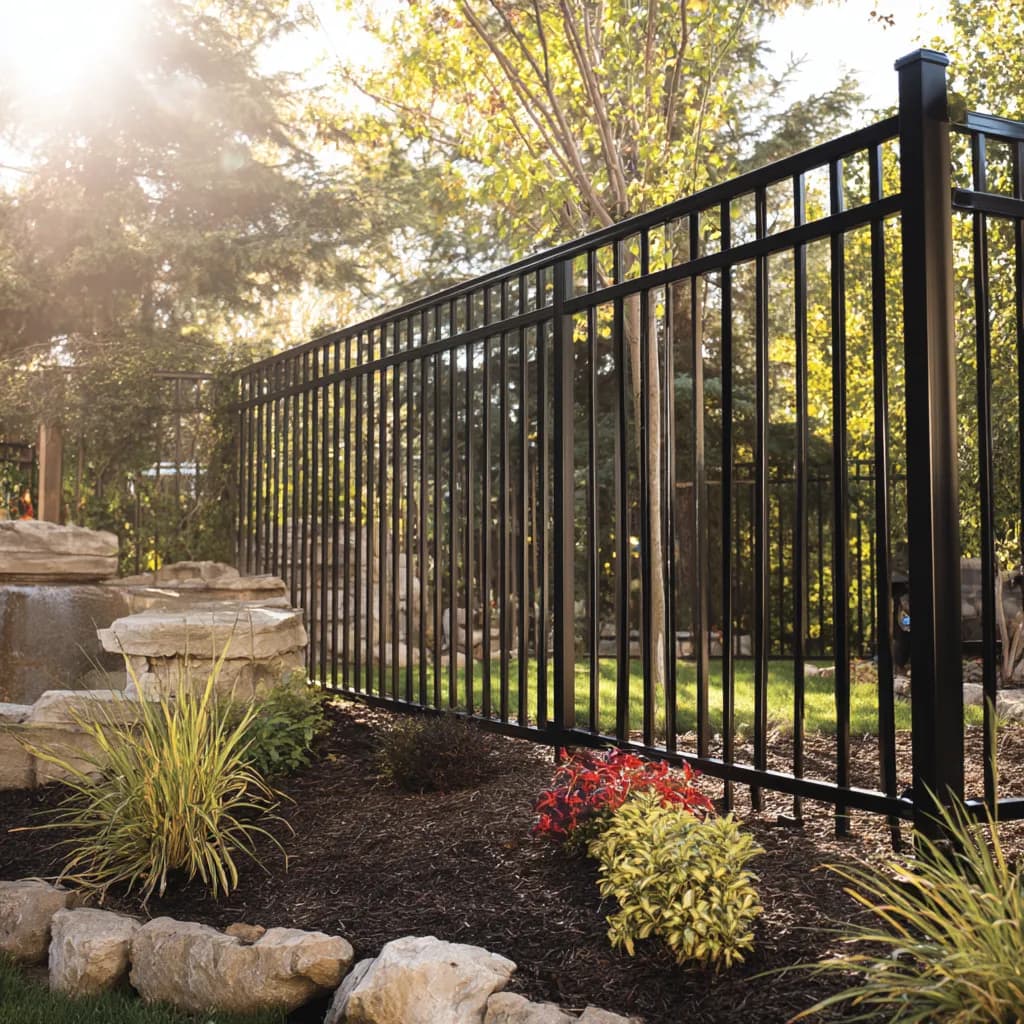
Pittsburgh is one of the hilliest cities in the country. Flat yards are the exception here, not the rule, and most homeowners in the South Hills, the North Hills, and the river valleys are working with some degree of grade change along their fence line. That slope affects everything: how the fence is installed, which materials are appropriate, where gates can go, and where problems are most likely to show up down the road.
Here is what to understand before a fence goes in on a sloped property.
The two ways to fence a slope
Every sloped fence installation comes down to one of two approaches, and understanding the difference is the starting point for every other decision.
Racking means the fence panels follow the slope of the ground continuously. The top rail angles with the grade, and the fence rises and falls with the terrain. It produces a smooth, flowing look and keeps the gap between the bottom of the fence and the ground consistent. Aluminum fencing handles racking well because the pickets can be adjusted individually during fabrication to follow the angle. Vinyl and mixed material panels are rigid and generally cannot be racked.
Stepping means the fence runs in level sections that drop in increments, like stairs. Each section is level, the posts between sections are taller on the downhill side, and there is a gap at the base of each step where the ground falls away. Stepping works with any material because each panel stays flat. The trade-off is those base gaps, which can be a problem for pet containment or erosion control. Stepping also creates a more angular visual compared to a racked fence.
Which approach is right depends on the degree of slope, the material, and what the fence needs to do. A gradual grade on a decorative aluminum fence is almost always racked. A steep drop with vinyl privacy panels is stepped. Steeper grades sometimes require a combination of both.
How slope affects each material
Not every fencing material handles a slope the same way, and the right choice on a flat yard is not automatically the right choice on a hill.
- Aluminum. The most versatile material on a slope. Aluminum pickets can be racked to follow grades that would be impossible with a panel-based system. It is the standard choice for decorative fencing on Pittsburgh's hillier lots.
- Vinyl. Rigid panels cannot rack, so vinyl is always stepped on a slope. This means visible gaps at the base of each section. Those gaps can be filled with gravel, landscape timbers, or concrete depending on the application, but it adds work and cost. On a modest grade, stepping works cleanly. On a steep or uneven slope, vinyl requires careful planning.
- Mixed material. The boards are vinyl in an aluminum frame, so how a given style handles a grade depends on the panel. We confirm the layout at the site visit.
- Chain link. Chain link can follow a slope reasonably well because the mesh is flexible. The tension wire at the base can be adjusted to hug the ground on a grade. It is not a clean solution on dramatic terrain, but for utility fencing on moderate slopes it performs well.
Post depth on a slope
Posts on sloped ground need to be set deeper than posts on level ground. The downhill side of each post carries more lateral load, and freeze-thaw cycles in Pittsburgh winters push on posts harder when the grade is working against them. A post that holds perfectly on flat ground can heave or lean within a season if it is set too shallow on a hill.
The other factor is footing diameter. Larger concrete footings distribute load better on sloped soil. A contractor cutting corners on footing size on flat ground may get away with it for years. On a slope, that shortcut shows up faster.
Ask your contractor specifically how they handle post depth and footing size on sloped ground. It is a direct indicator of whether they have real experience with Pittsburgh terrain or are applying a one-size approach.
Gate placement on a slope
Gates are the most complicated part of a sloped fence installation. A gate needs to swing freely without dragging on the ground, which means the clearance between the gate bottom and the ground has to account for the grade change across the gate opening.
On a slope, a gate that swings toward the uphill side will drag. A gate that swings toward the downhill side will have a large gap at the bottom on the uphill end. Neither is ideal without planning.
Solutions vary: cutting the gate bottom to follow the grade, using a level pad at the gate opening, adjusting hinge placement, or choosing a different gate location entirely. Before the job starts, walk the fence line with your contractor and discuss every planned gate location in the context of the slope. Changing gate placement after posts are set is significantly more work.
Base gaps and what to do about them
Stepped fence sections on a slope leave triangular gaps at the base where the ground falls away. On a decorative fence where containment is not the goal, this is mostly a visual issue. On a fence meant to keep pets in or wildlife out, those gaps are a real problem.
Common solutions include landscape timbers cut to fill the gap, concrete poured at the base, gravel fill, or a buried wire apron for pet enclosures. The right approach depends on the fence material, the size of the gap, and what the fence is meant to do. A good contractor will surface this issue before installation and propose a solution, not leave you to figure it out after the crew has left.
What to check before getting an estimate
Before you talk to a contractor, walk your fence line and note a few things: where the steepest grade changes are, where you want gates, and whether there are any sections where the slope changes direction. If you have an existing fence, look at where it has failed: shifted posts, sagging panels, or dragging gates are all slope-related problems that point toward what the next installation needs to account for.
If you are in the Pittsburgh area and working with a sloped yard, we install on graded terrain regularly across the South Hills and surrounding communities. Reach out for an estimate and we will walk the line with you before anything gets quoted.