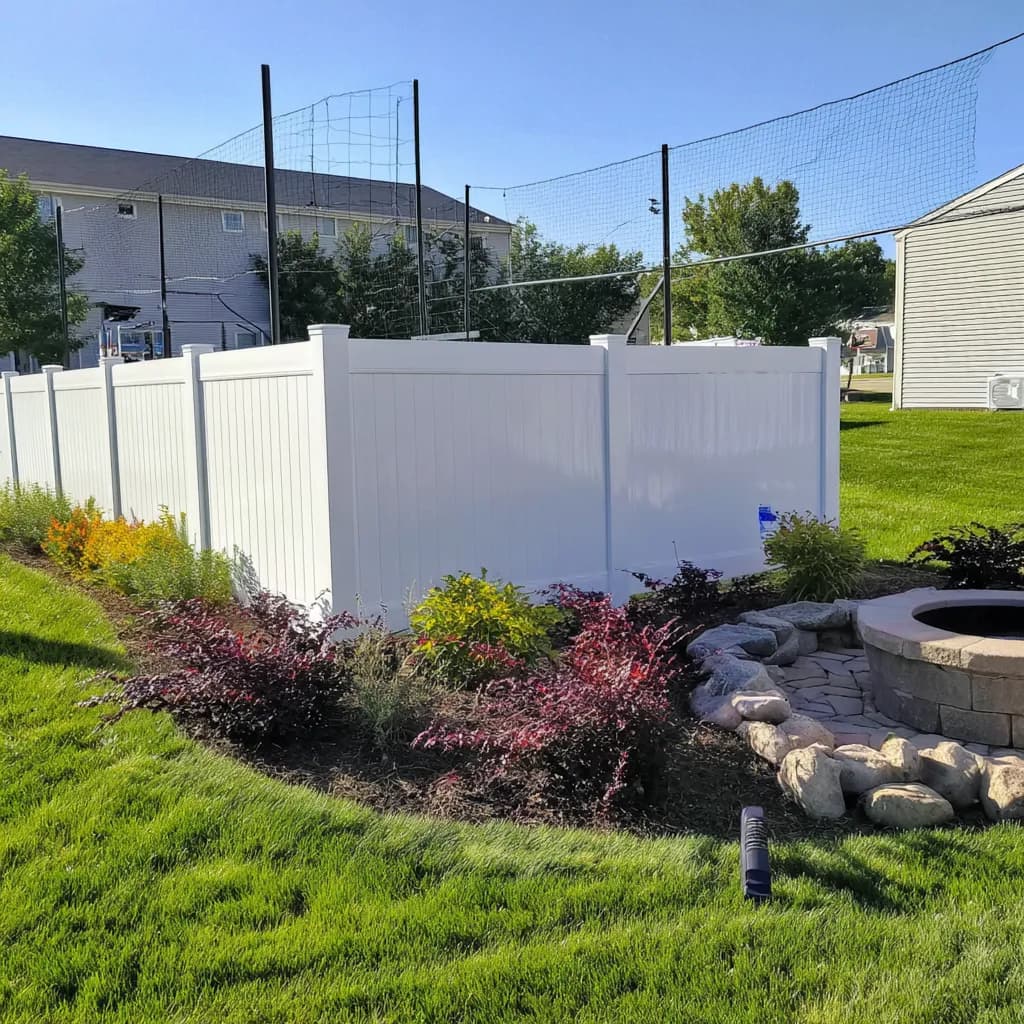
When a Pittsburgh homeowner wants privacy from a neighbor's window, a busy sidewalk, or a road behind the yard, the decision usually comes down to two very different approaches: build a privacy fence, or plant a living screen of arborvitae, hedges, or other evergreens. Both block the view. They do almost nothing else the same way.
There's no universal winner. The right choice depends on how fast you need the privacy, what you want to spend, how much maintenance you're willing to take on, and how the space needs to function. Here's how the two stack up.
Speed: a fence wins immediately
A privacy fence gives you the full result the day it's installed. Six feet of vinyl or composite goes up, and the sight line is gone that afternoon. For homeowners solving a specific problem (a new deck overlooked by a neighbor, a pool area that needs seclusion before summer), that immediacy is often the deciding factor.
A living screen is a multi-year project. Arborvitae planted at a common installation size of 5 to 6 feet will take several growing seasons to knit together into a solid wall, and Pittsburgh's growing season is not long. If you plant larger, more established stock, you shorten the wait, but the cost climbs quickly. Privacy from plants is something you wait for, not something you buy outright.
Cost: it depends on the timeline you're comparing
Up front, a modest run of arborvitae can look cheaper than a fence per linear foot, especially at smaller plant sizes. But that comparison is misleading unless you account for what each costs over time.
- A fence is a larger one-time cost with low ongoing expense. A quality vinyl or composite privacy fence installed correctly can last decades with minimal maintenance spending.
- A living screen can be cheaper to plant but carries recurring costs: irrigation in dry Pittsburgh summers, occasional replacement of plants that don't make it through a hard winter, and either your time or a landscaper's fee for shaping and upkeep.
For a fair comparison, price the fence against a living screen at a size that delivers privacy soon, plus a few years of maintenance. The gap narrows fast, and often flips. Our fence cost calculator can give you the fence side of that comparison in a few clicks.
Maintenance: a fence is lower effort, a hedge is a living thing
A powder-coated aluminum, vinyl, or composite fence is close to maintenance-free: an occasional rinse, a hardware check each spring, and little else. Nothing dies. Nothing needs watering.
A hedge or evergreen screen is a living system that needs ongoing care to stay dense and healthy. Arborvitae can thin out, brown from winter burn, or lose lower branches if crowded or stressed. Keeping a living screen looking like a clean privacy wall takes real work, and it's the kind of work that a professional often handles better than a homeowner with hand shears. Landscapers like Q&A Landscaping install privacy plantings and maintain them so the screen actually fills in the way it's supposed to, rather than turning patchy after a couple of seasons.
Where each one wins
Rather than declaring one better, it's more useful to match each to the situation.
A fence is the stronger choice when:
- You need privacy now, not in three years.
- The space is tight. A fence occupies a few inches of ground; a mature evergreen screen can need 3 to 5 feet of depth to grow into.
- You're enclosing a pool, where code requires a barrier of a specific height with a self-latching gate that a hedge simply cannot satisfy.
- You want a defined property boundary and containment for pets or kids.
- You'd rather not take on seasonal maintenance.
A living screen is the stronger choice when:
- You have the room and the patience to let it grow in.
- You want softness, seasonal texture, and something that muffles road noise and filters wind better than a solid panel.
- You're screening a long or irregular sight line where a continuous fence would feel heavy.
- You value the ecological side: pollinators, birds, and a greener backyard.
The option a lot of Pittsburgh yards land on: both
The two approaches aren't mutually exclusive, and some of the best-looking yards use them together. A privacy fence handles the immediate barrier and the code-driven requirements (pool enclosure, defined boundary), while plantings soften the fence line, add depth, and green up the space over time. A fence gives structure on day one; a living layer in front of or above it does the rest as it matures.
This pairing shows up constantly around pool areas, where a fence is non-negotiable for safety and code but a bare panel looks stark on its own. Thoughtful planting around the enclosure changes the whole feel of the space. Q&A Landscaping's guide to pool landscaping ideas for Pittsburgh yards walks through how plantings and hardscape work alongside a pool barrier rather than competing with it.
How to decide for your yard
Start with three questions: How soon do you need the privacy? How much ongoing maintenance are you willing to own? And does the space have a hard requirement, like a pool, that only a fence can meet? Those three usually point clearly in one direction, or toward doing both.
If a fence is part of the answer, we install privacy fencing across the South Hills and the surrounding Pittsburgh communities, and we're happy to walk your yard and talk through what fits before anything gets quoted. If the plan leans toward plantings, or a combination, a good landscaper is the right call for that side of the work.